|
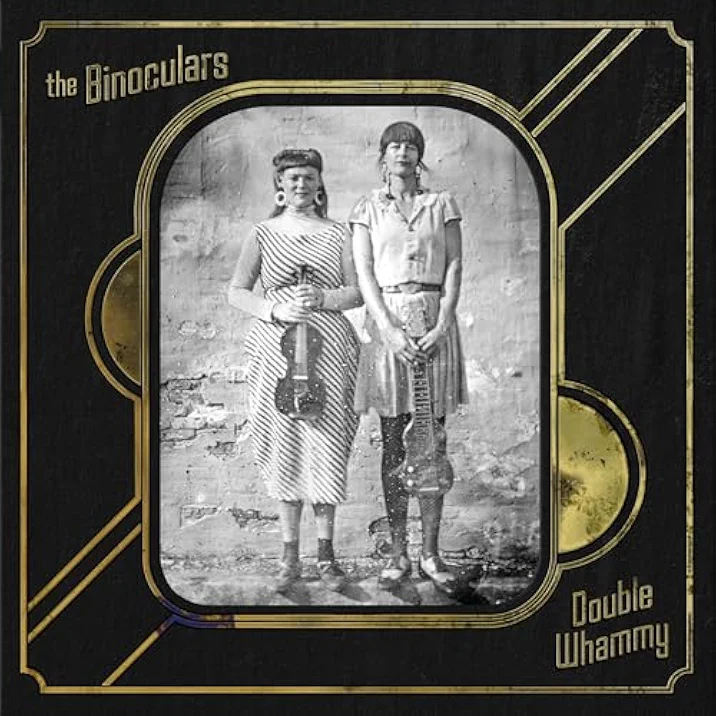
The Binoculars, Double Whammy (Jalopy, 2026) The Down Hill Strugglers, Old Juniper (Jalopy, 2024)
So far as I can discern, it is an improbable mash-up, in the vocal numbers, of generally obscure mid-century country songs and, in the fiddle-driven instrumentals, mainly Latin, Italian and Gypsy pop styles from another time. There is also a version of the revered Rosa Lee & Doc Watson death-haunted (yet paradoxically beloved) folk hymn "Your Long Journey." Otherwise, the bulk of the material here is from another, earlier iteration of the genre that was evolving into what was only lately being identified as "country," with harmonies out of the brother duets of the 1930s, '40s and '50s. The two most successful offerings were the Delmore Brothers and the Louvin Brothers (the latter covered here on "You're Running Wild" and "Lorene"). Otherwise the sources vary widely. Though I know my hillbilly history from a near-lifetime of listening and reading, I don't recognize most of the choices here. That never happens. The Binoculars -- so named, I surmise, from the image of a metaphorical landscape studied from a distance -- are Kaethe Hostetter and Chloe Swantther, friends who grew up together in Brooklyn, New York, and who ingested idiosyncratic musical tastes together. They perform them (on fiddles and guitars) with a unique purity on both instrumental and singing sides. The result is something like an Appalachian string band gone rogue, only with impressive discipline and focus.
My review of their Lone Prairie was posted in this space on 1 July 2017. There I remark on how natural the music sounds coming from the three performers (Eli Smith, Walker Shepard and Jackson Lynch) even though none grew up in the tradition. Still, they did grow up in a tradition, namely the New Lost City Ramblers, which brought Appalachian stringband sounds to the urban revival of the 1950s and '60s. The NLCR were far removed from the slick pop groups that defined "folk music" for a mass audience in those days but were a significant influence on subsequent rock acts such as the Grateful Dead, whose famous "Uncle John's Band" is thought to be a tribute. The "Uncle John" is likely NLCR founder and longtime member John Cohen, since deceased, who encouraged the Strugglers in their early days and even recorded with them. Hearing the NLCR for the first time has to be ranked among the most profound musical experiences I would ever undergo, and it is not too much to say that it changed my world -- in all kinds of unexpected contexts -- permanently. The Strugglers have done honor, and more, to the group Cohen, Mike Seeker and Tom Paley (later replaced by Tracy Schwarz) played in. Beyond that, they have infused their own approach. Old Juniper continues the tradition but adds an element I would have judged so confounding as barely to be worth the effort: flawless, eerily in-the-tradition songwriting. These consist of 11 originals, all conceived in ways that only those almost preternaturally absorbed in the style could have replicated so capably. If you didn't know better, you would think these were songs that had lain buried in the hills and hollers till now. Every one is a gem. How did the Strugglers do it? It's not an unanswerable question, but I'll let you listen and figure it out for yourself. Be prepared: Along the way, joy will embrace you. 

|
 Rambles.NET music review by Jerome Clark 10 October 2026 Agree? Disagree? Send us your opinions!  Click on a cover image to make a selection. 



 |