|
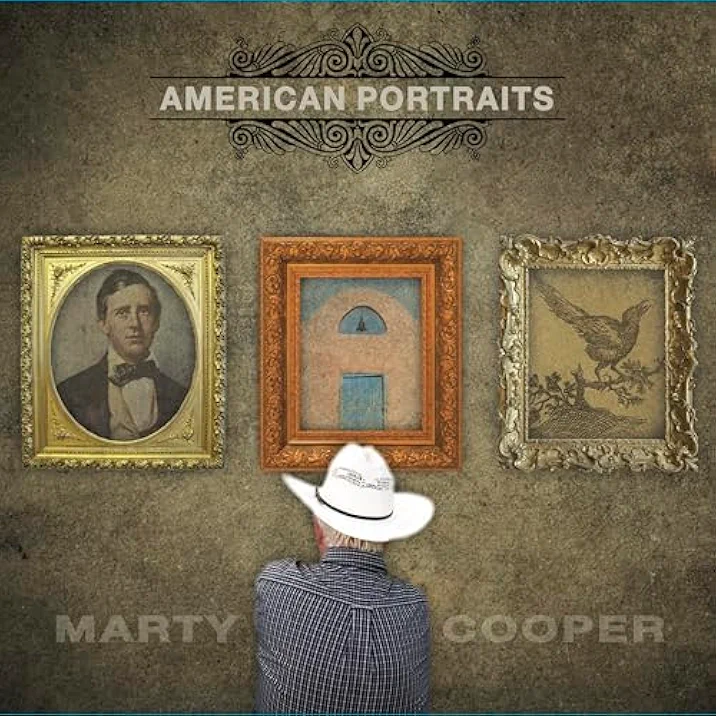
Marty Cooper, American Portraits (Howlin' Dog, 2025) In these times, which are not good ones, this American patriot wonders if he is living in the nation he thought he knew. I experienced comparable anxiety and confusion during the Vietnam War, when the nation appeared to be headed for an acrimonious divorce and little around me felt recognizable. After the war and Watergate had run their course, relief set in, and we allowed ourselves to think the old America, or at least a reformed version of it, had been restored for us, our children, and all to come. America and democracy were still, for all the asterisks, uncontroversially synonymous. Little did we know. I'm old enough to recall that before all the convulsions, there was a sense, in evidence during the allegedly placid 1950s as well, that a better, purer America had once graced the landscape. In the tiny Midwestern town of my early years -- and not just there; a leading historical journalist wrote a book, un-ironically titled The Good Years, on that era -- mythology placed that golden age in the 1890s. At community functions local singers and pianists revisited the hits, composed for stage and parlor, of that distant decade. Weirdly, they were sentimental and nostalgic enough to lead you to believe, if you thought about it (nobody did), that even back then the golden age was deemed to be some time well before the 1890s. No one actually lives in a golden age, which is never there in the present tense.
In my adult life, informed by both direct experience and long immersion in historical literature, I have come to pride myself on my philosophical contempt for sentimentality. The good old days, I know, were good only for some, almost always the wealthy, while only sporadically joyful for those who were at their service. On American Portraits Marty Cooper opens with "Stephen," about our first great songwriter after our native, British-based folk tradition (thought, or at least at one time, to have begun with "On Springfield Mountain," about a young man bitten to death by a poisonous snake). Keep in mind that some of Stephen Foster's most fondly cherished songs consist of homesick sentiments put into the mouths of slaves longing for lost lives on previous plantations. If you need evidence of the fundamental, oblivious unreality of nostalgia, there it is. American Portraits is about another country, not so much long gone as barely ever extant, just like all those songs people sang in the good old days, though yet unrecognized as such, about the good old days whose passing they lamented. It amounts to nostalgia for nostalgia. On one level the delusion is obvious to any thinking listener. On another, being human, we aren't able consistently to resist the beguiling fantasy, which may possess a sweet appeal that captures the most cynical for at least a few unguarded moments. I confess to being partial to "On the Banks of the Wabash, Far Away." It is also true that not everything in our past, personal and collective, merits no more than our amnesia. On occasion I fantasize about boarding a time machine and checking out something specific. I always end up in 1920s Mississippi watching the bluesman Charlie Patton perform live on a street corner or at a social gathering. All I know from the evidence is that many of those who got to do that, white and black alike, treasured the experience when they spoke of it to a later generation of researchers. A retired producer and songwriter who spent his career in the pop-music industry in Southern California, Cooper wraps his album in a warm fuzz of pseudo-memory. To be fair, everything is not a meditation on vanished delight -- death and war are acknowledged, too -- but still, in these metaphorical grooves everything is disappearing into fading memory, usually to pretty, sorrowful tunes, as it takes the narrators (cowboys, baseball players, railroaders, soldiers) with it. Portraits is a series of last wills and testaments. It's an American chimera always slipping from our hands just before the dreamers turn into ghosts. Beyond that, it's enjoyable. If you think of yourself as cool, consider it a guilty pleasure. The only album I can compare it to is the late John Stewart's California Bloodlines (1969), which also arrived during a time of national agony. For various reasons Stewart's has been judged a certifiable classic in spite of its occasional bathetic excess (e.g., "Mother Country"). For all its accessibility, I doubt that American Portraits will claim the same enduring reputation. Still, if it doesn't honor an authentic nation, it does ably represent an authentic American dream about itself. 
|
 Rambles.NET music review by Jerome Clark 6 September 2025 Agree? Disagree? Send us your opinions!  



 |