|
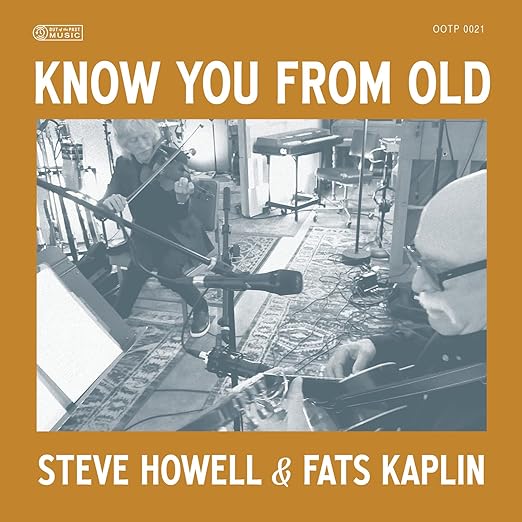
Steve Howell & Fats Kaplin, Know You from Old (Out of the Past, 2025) Those of you who know your traditional music will recognize the quote in the title. It appears in a version of "The Cuckoo," of British origin and hundreds of years and numerous variants removed from its point of origin. The one Steve Howell & Fats Kaplin perform on Know You from Old was a standard in the folk revival of the late 1950s to the mid-1960s, learned from the North Carolina banjo player Clarence "Tom" Ashley, who cut it in the '20s and lived long enough to sing it on stage decades later with his younger friend and colleague Doc Watson.
Of the songs on this album, "Cuckoo" probably has the longest pedigree, seconded by "The Escape of Old John Webb," inspired by real events in the mid-1700s and refitted for storytelling purposes from a ballad that had circulated from two centuries earlier. (Unburdened by copyright laws, traditional songs often have tangled -- maybe the word is cannibalized -- histories.) It is one of two traditional songs I had never heard, or heard of, heretofore on this new disc. A web search suggests that though the Kingston Trio recorded it on a 1960 album, it remained a revival rarity. It's not clear why. It's a charming true-crime yarn, and many thanks to Howell & Kaplin for bringing it back from silence. Speaking of tangled histories, I come to my favorite track. I've heard no version I didn't like, probably because only artists I respect would cover it in the first place. No unworthy (or at least uninformed) soul, in other words, would ever tackle it. I refer to "Shawneetown," which on everybody's initial impression is the creation of early 19th-century Ohio River boatmen, one of whose land destinations would have been this village in southeastern Illinois (pop. 1,054 in the 2020 census). In reality, the narrative was constructed around fragments from two separate songs that folksinger/folklorist/playwright Dillon Bustin found in a 1969 book, The Keelboat Age on Western Waters. The fragments comprise the first verse and the chorus, and the rest, along with the exquisite melody, is the product of Bustin's imagination. As one who once tried, I find this remarkable. It is virtually impossible to write anything that can pass for an actual folk song. I suspect that's because a folk song that is cobbled together out of a lost and unrecoverable cultural language is just about impossible to fake. "Buffalo Skinners," made famous in the repertoires of Woody Guthrie and Ramblin' Jack Elliott (particularly the latter), is a genuine period piece, one of those thoroughly unsentimental ballads as far removed from the whimsical Western pop of later decades as songs can get. Hearing it now, I was struck by its plot and atmospheric resemblance to what could be a dark, romance-crushing Cormac McCarthy novel. Howell & Kaplin deliver a suitably grave reading that stresses the murder and betrayal at its heart. "Cold Haily Windy Night" (aka " Cold Blow and a Rainy Night") is just as noirish if not as bloody -- seduction and abandonment, not homicide, is the theme of this vividly told English song, which American listeners may recognize from versions by Steeleye Span and Martin Carthy. This is the eighth album by acoustic guitarist and singer Steve Howell (with or without band or other accompaniment) that I have reviewed in this space since 2015. It's also the second in 2025. From Texas, Howell is distinctive in eschewing the Lone Star State's singer-songwriter trade and choosing -- refreshingly -- to cover songs, as his label boasts, "out of the past." (I am surprised that this particular choice is legal where he resides.) That past encompasses, with the occasional exception, folk, blues, jazz and vintage pop, the sort of stuff people heard before rock 'n' roll claimed all our attention. It's sparely arranged, with vocals that are anything but fancy but somehow always appealing. This time around, the respected Fats Kaplin, on folk-associated stringed instruments (fiddle, mandolin, various banjos, bouzouki), ably joins him, switching from American Songbag to American Songbook on the last two cuts (#12 and #13). I've been listening almost exclusively to Know You from Old over the past week. As they like to say in fashionable-expression country, it's all good. Then again, given all that history personal and musical, why wouldn't it be? 
|
 Rambles.NET music review by Jerome Clark 8 November 2025 Agree? Disagree? Send us your opinions!  



 |