|
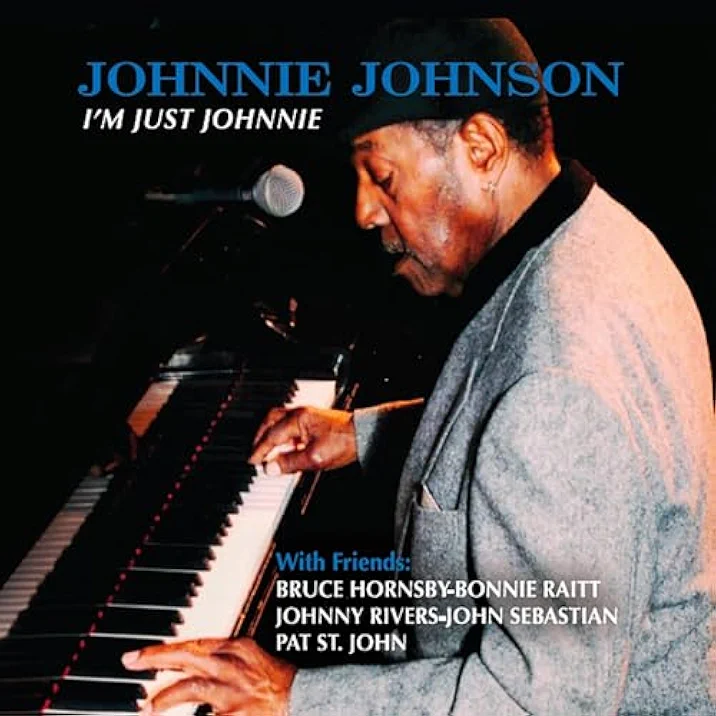
Johnnie Johnson, I'm Just Johnnie (Missouri Morning, 2025) Whether you know it or not, you've heard Johnnie Johnson. Well, I suppose it's possible that somehow, following a lifetime living in a cave, you've missed hearing "Brown-Eyed Handsome Man," "Roll Over Beethoven," "Back in the USA," "Too Much Monkey Business," "Nadine" and other classics that rendered Chuck Berry a rock immortal. But I would guess it's unlikely. All of that started in the early 1950s when Berry joined Johnson's trio, which he soon took over, elevated his guitar to lead instrument, and brought his skills as an entertainer to the fore. Berry added songs, most credited to himself, to the program, and as rock 'n' roll emerged as a thrilling new genre, so did Berry hits, which in short order were integral to the music's vocabulary. Johnson and Berry parted company in 1973, and Johnson ended up playing blues and jazz, in good part in and around St. Louis where he lived from 1952 to the end of his life. He recorded occasionally, though he never achieved actual stardom, but his reputation grew into legend over time. He played on recordings with Eric Clapton and Keith Richards. He eventually was invited into the Rock & Roll Hall of Fame.
I'm Just Johnnie, Johnson's just-released posthumous album, was recorded in various sessions between 2003 and 2004 under the guidance of producer and friend Gene Ackmann, with occasional participation by Bruce Hornsby, Bonnie Raitt, Johnny Rivers and John Sebastian. Except for Sebastian and Raitt, whom one has no trouble imagining in the same room, that strikes me as an eclectic group. When they appear occasionally, it's not together (with the exception of Hornsby [co-vocal] and Raitt [slide guitar] on the standard "Every Day I Have the Blues," B.B. King's signature piece), and each appears only once. Rivers contributes "Johnnie Johnson Blues," which the ordinarily low-key Johnson sings in what amounts to a tribute to himself, though it's clear that Rivers knows Johnson's music intimately and holds Johnson in the highest esteem. I have listened to this album almost daily since it showed up in my mail two or three weeks ago. It's hard to believe Johnson's time was about to run out when he participated. Those who knew him often remarked on how much joy visibly infused him when he played (Rivers mentions as much in his song), and on this album he has all the enthusiasm of a young man in front of as crack a band as you're going to hear. The songs, uniformly strong, are covers, some Johnson co-writes, all perfectly suited to him: "not too slow, not too fast," he would say. There's "Stagger Lee," the celebrated Lloyd Price 1958 chart-topper and the only version most people have ever heard. In fact, its origins go back to 1895 after a murder of an underworld character in a St. Louis dive. In the fashion of other folk ballads, there were as many versions as singers sang them, in this instance till Price codified the lyrics and melody. The song here, identical to Price's, is credited to an unlikely collaboration of Robert Hunter (the late Grateful Dead lyricist) and Mississippi John Hurt (who recorded his own variant in 1928). A companion CD in an accompanying sleeve carries interviews with the amiable Mr. Johnson who details his musical history and philosophy. The Interviewer, New York City DJ Pat St. John, takes Johnson's side in the composer's dispute with the departed Mr. Berry. Johnson doesn't say much but pointedly does not argue with him. Though recorded more than two decades ago, I'm Just Johnnie sounds as fresh as a few months ago. It will be judged, I expect, one of the most enduring blues albums of 2025. 
|
 Rambles.NET music review by Jerome Clark 30 August 2025 Agree? Disagree? Send us your opinions!  



 |