|
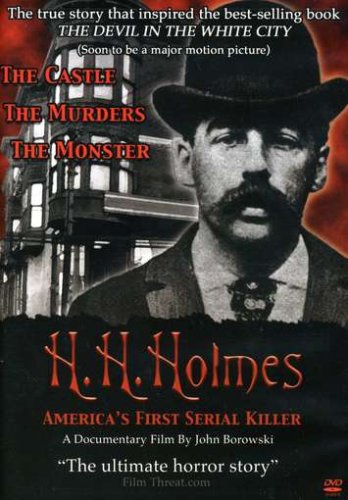
H.H. Holmes: America's First Serial Killer, directed by John Borowski (Virgil Films, 2004)
Frankly, I don't find the man all that interesting -- and I'm not entirely sure why. Given his deeds and my fascination with serial killers, this man should be up there with Ted Bundy, Jack the Ripper and the Green River Killer for me -- but he isn't. Maybe it's just because he was such a puny, cowardly sort of fellow who wasn't even man enough to do his work up close and personal. No, this guy relied on gas, poison and asphyxiation to rob his innocent victims of their lives. He only grew a pair after the killing was done, chopping up and burning the bodies or, in several cases, stripping them to the bone and selling their skeletons to medical schools. What should make H.H. Holmes interesting is the fact that he really doesn't fit the profile of your typical serial killer. For one thing, he was highly educated, having received his medical degree from the University of Michigan. He didn't exactly fly under the radar, either, as he was quite brazen in terms of conning people out of their money and buying things on credit and never paying for them. Then there is the "Murder Castle," the three-story, 60-room monstrosity he had built in Chicago. This was no boy next door, and I daresay you would have had a hard time finding any of his neighbors going on about how shocked they are and what a nice man he was once his true nature was revealed. This documentary does an excellent job of following Holmes from his birth as Herman Webster Mudgett in 1861 to his death (by hanging) in 1896. The most interesting part of the story, of course, is the "Murder Castle," and the narrative goes into some detail as to the manner in which he killed his victims -- such as pumping gas into their sealed rooms or locking them (including one of his wives) in a giant steel vault to die a slow death by asphyxiation -- and the postmortem liberties he took with their bodies (his basement boasted two giant furnaces, a stretching rack, pits of acid, a variety of poisons and a bloody dissection table). The documentary also helps explain why he was not suspected of murder much sooner. First and foremost is the fact that these killings took place in the 1890s, long before the advent of modern forensics and several years before fingerprints were used by police. There's also the design of his "castle," which allowed for quiet killings in soundproof rooms and the quick removal of the bodies down a specially designed chute to the basement. Then there was the Chicago World's Fair of 1893. Holmes rented out rooms in his "castle" to visitors, some of whom just never returned home. They were almost perfect victims because their friends and family back home would have no reason to link their disappearances to Holmes. The documentary takes us through the international news event that was the trial and the defendant's shenanigans in court. Then we learn how, following the pronouncement of his death sentence, Holmes decided to take credit for all of his crimes and then some, only to recant for the most part on the gallows. As should be obvious, H.H. Holmes was uniquely diabolical and is thus most worthy of study. If the evil that men do lives on and on, then we need to understand the most evil of men, and Holmes definitely fits into that category. 
|
 Rambles.NET review by Daniel Jolley 6 June 2026 Agree? Disagree? Send us your opinions!  



 |