|
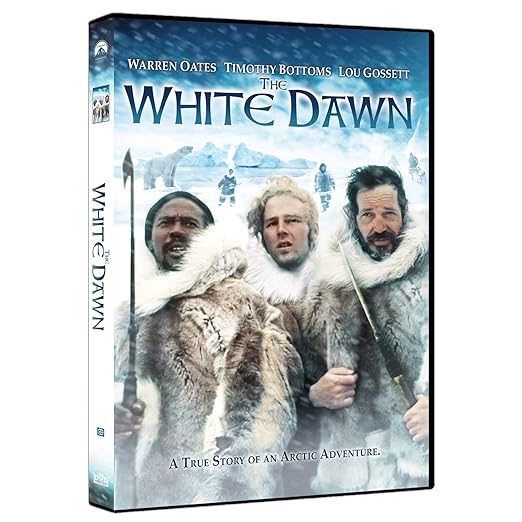
The White Dawn, directed by Philip Kaufman (Paramount, 1974) The White Dawn is based on the novel by James Houston that chronicles a true story. It was filmed on Baffin Island where the events happened. Immediately following the title, the film proclaims: "Featuring the Eskimo People of the Canadian Arctic." This is a sign of the release date, which was clearly before we learned that the "politically correct" name for these people is Inuits. This film far surpasses any I have seen with the "Eskimo People," perhaps because it is based on an actual event or perhaps because it was filmed where the event happened and using the actual people who live there. Either way, this is an outstanding look at these people.
Inuits spot the men and carry them by dogsled back to their village. Sarkak (Simonie Kopapik), the leader, tells the village the men are half man and half dog, created by the Dog Spirits mating with one of the ancient Inuit women. They are the Dog Children. The men could not be more different. Billy (Warren Oates) is the hateful, domineering third mate who sees only the worst. He is mean, unappreciative, dastardly, and an all-around horse's rear end. The more the Inuits try to help him, the worse he treats them. Portagee (Louis Gossett) is untrusting and fearful at first, but he seems to settle down a slight bit after a few days. Still, he is not eager to join in. Beckett (Timothy Bottoms) is warm and friendly. He appreciates being rescued and having a warm place to sleep. He is eager to learn, joins right in with whatever they are doing, and attempts to learn their language. The shaman (Sagiaktok) visits and tells Sarkak that the whalers are bad luck, but Sarkak still befriends them. The next time the shaman visits, he repeats the warning that they are bad. Sailors being what sailors are, Billy decides the berries the children picked for them are not good to eat, but they will make a fine drink. Soon they have the whole clan drunk. Beckett falls in love with Sarkak's young wife, Neevee (Pilitak). While he is professing his love and talking about wanting to stay forever, Billy is getting sloppy drunk and wanting to cut somebody. Then, tragedy strikes. A lot of viewers may not like the fact that the Inuits speak in their native language, so you have to read the subtitles to understand. The flip side is that it is easy for you to understand how the sailors feel as they try to love in a village where they do not speak the language or know the rules and customs. If you are really game for understanding, watch it once with the subtitles turned off. The camera work is outstanding. The action is clean and clear. They did an especially nice job with the moving dogsleds. That seems to be a difficult thing to film, judging by how many bad dogsled scenes are on the market. I really enjoyed the soundtrack and felt it supported and complemented the action quite well. The acting is fantastic. I suppose the ultimate test of an actor's ability is if they can convey meaning to a person who does not speak their language. This cast does it with an apparent ease. The writing is also excellent. There is almost always a fair level of suspense. I was shocked by the ending. It was not how I "knew" it was going to happen, but it certainly tied up all of the loose ends. I was shocked to see the "wind witches" during the Inuit ceremony. This is the first time that I have actually seen it on film, although I have read it. I am just surprised that the Inuit people allowed it to be filmed. The scenes with their ceremonies, games and dancing are fascinating. The White Dawn is an excellent movie from all angles. If you simply want a movie for entertainment, this one delivers the goods. But it is also a magnificent film for learning about the Inuit culture and one of those isolated moments from America's history. Either way, it is a smart choice. 
|
 Rambles.NET review by Alicia Karen Elkins Agree? Disagree? Send us your opinions!  



 |